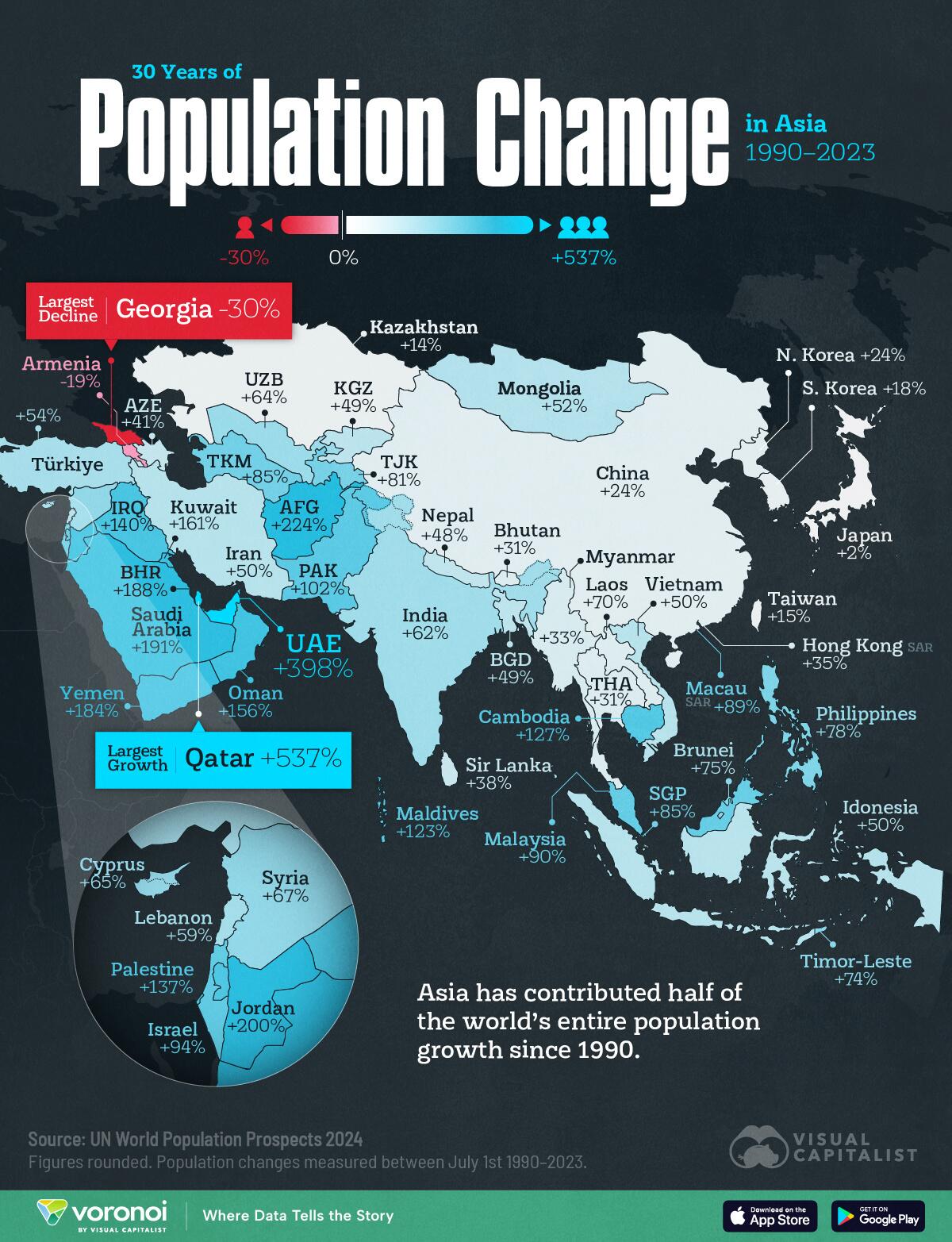
How Populations Have Changed In Asia Since 1990
Since 1990, the world population has grown by 3 billion people. And half of those births occurred in Asia.
But which countries have seen the most (relative) growth, and have any declined?
Visual Capitalist’s Pallavi Rao maps out the changes in population for every Asian country between 1990 and 2023.
Data was sourced from the UN’s World Population Prospects 2024, and all figures are rounded.
Ranked: Asian Countries by Population Change (1990–2023)
The Middle East has seen the largest relative population growth in Asia, in some cases up 3-6x as seen in Qatar, UAE, Saudi Arabia.
Rank
Country
% Change
(1990–2023)
2023 Population
(Thousands)
1
🇶🇦 Qatar
537
2,979
2
🇦🇪 UAE
398
10,642
3
🇦🇫 Afghanistan
224
41,455
4
🇯🇴 Jordan
200
11,439
5
🇸🇦 Saudi Arabia
191
33,264
6
🇧🇭 Bahrain
188
1,570
7
🇾🇪 Yemen
184
39,391
8
🇰🇼 Kuwait
161
4,839
9
🇴🇲 Oman
156
5,049
10
🇮🇶 Iraq
140
45,074
11
🇵🇸 Palestine
137
5,409
12
🇰🇭 Cambodia
127
17,424
13
🇲🇻 Maldives
123
526
14
🇵🇰 Pakistan
102
247,504
15
🇮🇱 Israel
94
9,256
16
🇲🇾 Malaysia
90
35,126
17
🇲🇴 Macao
89
714
18
🇸🇬 Singapore
85
5,789
19
🇹🇲 Turkmenistan
85
7,364
20
🇹🇯 Tajikistan
81
10,390
21
🇵🇭 Philippines
78
114,891
22
🇧🇳 Brunei
75
459
23
🇹🇱 Timor-Leste
74
1,384
24
🇱🇦 Laos
70
7,665
25
🇸🇾 Syria
67
23,595
26
🇨🇾 Cyprus
65
1,345
27
🇺🇿 Uzbekistan
64
35,652
28
🇮🇳 India
62
1,438,070
29
🇱🇧 Lebanon
59
5,773
30
🇹🇷 Türkiye
54
87,271
31
🇲🇳 Mongolia
52
3,432
32
🇮🇷 Iran
50
90,609
33
🇮🇩 Indonesia
50
281,190
34
🇻🇳 Vietnam
50
100,352
35
🇰🇬 Kyrgyzstan
49
7,074
36
🇧🇩 Bangladesh
49
171,467
37
🇳🇵 Nepal
48
29,695
38
🇦🇿 Azerbaijan
41
10,318
39
🇱🇰 Sri Lanka
38
22,972
40
🇭🇰 Hong Kong
35
7,443
41
🇲🇲 Myanmar
33
54,134
42
🇹🇭 Thailand
31
71,702
43
🇧🇹 Bhutan
31
786
44
🇰🇵 North Korea
24
26,418
45
🇨🇳 China
24
1,422,585
46
🇰🇷 South Korea
18
51,749
47
🇹🇼 Taiwan
15
23,317
48
🇰🇿 Kazakhstan
14
20,330
49
🇯🇵 Japan
2
124,371
50
🇦🇲 Armenia
-19
2,943
51
🇬🇪 Georgia
-30
3,807
On the whole, nearly all Asian countries have added significantly to their people in the last three decades, including some of the world’s most populous countries: India (+62%), China (+24%), Indonesia (+50%), and Pakistan (+102%).
Only two transcontinental countries—Armenia and Georgia—have seen population declines. War is a primary reason for both, leading to economic repercussions, in turn fuelling an exodus of people.
Chasing Demographic Dividends
This explosion in people has also fueled Asia’s economic growth, particularly in China and India, from surging demand for goods and services.
In fact, Asia now has the highest share of world GDP (36%), eclipsing North America (31%) by five percentage points.
At the same time, many parts of the continent are still struggling with food insecurity, poverty, and civil strife. And for many of its advanced economies, the demographic dividend is ending. As birth rates fall, and the population ages, social security nets may not be able to keep up with increasing demands.
Wondering what this map looks like for other regions in the world? Check out Mapped: Population Change in the Americas (1990–2023) for a similar breakdown.
Tyler Durden
Sat, 12/07/2024 – 22:45
https://www.zerohedge.com/geopolitical/how-populations-have-changed-asia-1990